Cui Feng
The Killing RoomCui Feng is a clinic owner, political insider, and the central figure behind the illicit organ trade uncovered in the investigation of the murdered women. His public identity as a courteous provider of abortion services is set against the exploitation of patients’ medical records and the political influence he uses to obstruct scrutiny. The contrast becomes decisive when Li Yan must choose between revenge and the law: he arrests Cui on suspicion of at least fifty-four murders.
Public Position and Medical Persona
Cui is introduced at a banquet as a personal friend of Director Hu. There he challenges Margaret Campbell on the One-Child Policy, agreeing that it is a necessary evil while defending the improvements in living standards and life expectancy he attributes to family planning. When Margaret accuses him of profiting from other people’s misery, he acknowledges that his organization is in business to make money. He also presents its counseling and advice as more humane than the production-line treatment patients might receive at state hospitals. The exchange establishes the language with which Cui makes his enterprise respectable: commercial interest is admitted, but framed as compatible with professional care.
His influence is not merely social. When Li Yan proposes checking clinic records against missing-person files, Section Chief Huang warns that Cui is a Party member and an influential community figure, and insists that the department must not damage his reputation. Huang eventually permits the investigators to request access, but the warning has already defined the limits placed on their inquiry. Cui’s political standing makes even a routine request for records a sensitive act.
The Shanghai World Clinic
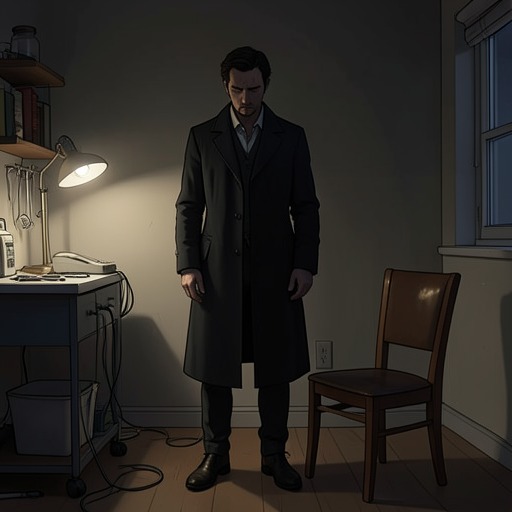
Cui’s central clinic occupies a red-roofed villa on a quiet residential street near the consular district, in an area once at the heart of the old French Concession. Its high gate, dense trees, discreet setting, double-glazed windows, and vertical blinds conceal the building from the street. Inside, the investigators pass original Chinese scroll paintings and a patient in a wheelchair before entering a study furnished more like an affluent private residence than a modest medical facility. Cui receives Li and Nien Mei-Ling in an expensive suit, speaking softly and greeting them with the manner of a reassuring family doctor.
The clinic’s presentation supports Cui’s cultivated image, but the investigators’ request exposes a conflict between patient confidentiality and the need to identify the dead. Cui agrees that his staff can compare his files with the missing-person records, while reserving the comparison for an employee so the clinic can maintain confidentiality. Li wants direct access, but Nien Mei-Ling signals him not to insist. Remembering Huang’s warning about Cui’s status and connections, Li accepts the limited arrangement. The polite meeting thus ends with the investigation dependent on a process Cui can control.
That restriction soon becomes an outright barrier. The Commissioner tells Li that Cui is too influential for the investigation to proceed through his files and orders him to find another route to identifying the women. Later, when police enter the clinic, the filing cabinets are open and empty; no records remain in the reception area, only a half-drunk mug of tea suggesting a hurried departure. Li orders the officers to identify the clinic’s employees and seek warrants for them, explicitly including Cui. The missing files have turned a politically managed request into a more urgent search for independent evidence.
The Victims and the Investigation
Margaret’s autopsy work supplies the first crucial link. In several victims, adhesions had scarred the inner lining of the uterus so that she could not pass her forceps through the cervix in her usual manner. She connects this finding to the effects of careless abortion, recalling both an acrobat’s abortion and a similar observation by Dr Wang in Beijing. Li then announces the breakthrough to the team: every identified victim had undergone an abortion. The discovery changes the investigation from a search for randomly selected women into an inquiry about what their histories might have made them identifiable for.
The clinic records offer a possible path to names, but the initial checks already point toward Cui. Relatives of four of the five victims identified so far report that the women had abortions at clinics belonging to him. Huang responds that this is unsurprising because Cui’s organization performs most abortions in Shanghai, and argues against treating the association as inherently suspicious. Li agrees that he is not accusing Cui simply because patients used his clinics; he wants the files to compare those patients with missing-person reports and identify the remaining victims. The distinction matters: the medical service is widespread, but its records may also contain information that could be exploited.
A further connection emerges through Jiang Baofu, the medical student who had worked vacation jobs at various hospitals and clinics. Dai notices on Jiang’s résumé that one of those jobs was at the Shanghai World Clinic. This places a person connected to the handling and burial of the bodies inside Cui’s institution, though it does not by itself establish what Cui knew. Li later argues that the clinic’s small scale makes ignorance difficult to believe: it is a converted villa with two small operating theatres and a handful of special-care beds, not a large hospital in which dozens of murders could easily remain invisible. That is Li’s case against Cui, made before the arrest warrant is issued.
Organ Trade and Abuse of Patient Records
Margaret’s later reconstruction explains why the victims’ abortion histories could have been more than a shared medical circumstance. Drawing on information about Japanese resistance to organ donation and the treatment of the dead, she concludes that the women were selected as matches for specific Japanese recipients with money to pay. She reasons that women passing through Cui’s clinics could have been tissue-typed during their procedures, creating a vast set of potential matches. In her account, the women were then taken and their organs removed without consent. This is presented as Margaret’s explanation of the pattern: the records that might have helped identify the victims could also have enabled their selection.
Her theory also connects the Shanghai murders to the earlier killing in Beijing. Margaret believes the woman there was targeted because her HLA DQ-alpha gene was unusually rare in China and might have made her a valuable match. The operation failed to benefit its intended recipient because the woman was a heroin user, but her case, like the others, fits Margaret’s conclusion that the victims were chosen for medical compatibility rather than at random. Cui’s clinics therefore occupy two sides of the same system: they provide a legitimate service used by many women, while their accumulated patient information could, in the investigation’s emerging account, be converted into a resource for an illicit market.
Exposure and Arrest
The evidence against Cui develops amid institutional resistance. Yue dismisses the case as resting on the testimony of a supposedly demented medical student and argues that any procedures could have taken place without Cui’s knowledge. Li counters that more than forty women could not plausibly have been surgically murdered in a small clinic under Cui’s own office without his awareness. The disagreement is not simply about the reliability of one witness: it is also about whether Cui’s influence will be allowed to outweigh the scale and setting of the crimes.
Huang eventually reveals that Cui proposed having Xinxin abducted to distract Li from the investigation long enough to cover his tracks. This disclosure makes the obstruction personal as well as political: Cui’s response to pressure is to threaten Li through his family. When Li confronts him, he has a gun and wants to kill the man he sees as responsible, but Dai’s quiet intervention gives him time to stop. Li instead produces the arrest warrant, charging Cui on suspicion of murder, with the count beginning at fifty-four and expected to rise. Officers handcuff Cui and lead him away. His arrest is not presented as a conviction, but it marks the point at which his influence no longer prevents the investigation from naming him as its principal suspect.
Cui’s character is built around the gap between benevolent appearance and concealed use of power. At the banquet he speaks of counseling and public health; at his clinic he invokes confidentiality; through his political connections he limits access to records; and, as the investigation closes in, he arranges an abduction to protect himself. Li’s refusal to shoot him gives that contrast its final consequence. Cui leaves under arrest, while Li chooses legal accountability over private vengeance.